Covalent
A lightweight Java component model and runtime container.
Home | Previous: Ecosystem - Architecture | Next: Covalent Annotations Cheat Sheet
Table of Contents
This page is the architecture reference for the Rubik’s Cube Solver demo: every top-level composite, how they depend on one another, the interfaces shared between them, the internal MVIC decomposition of each function, and how the HMI is assembled from all of it. It complements the demo’s entry in the Examples Guide, which covers what the demo does and how to use it - this page is about how it is built.
Top-Level Composites
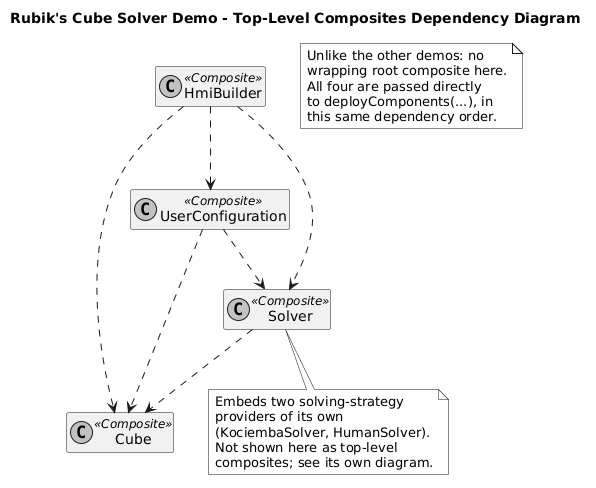
Four top-level composites: Cube, Solver, UserConfiguration and
HmiBuilder. Unlike Neural Network Trainer, Solar System Simulation and
Ecosystem, none of them is wrapped in a single root composite. The launcher
passes five classes directly to container.deployComponents(...), in this
same dependency order: the HMI core, then CubeImpl, SolverImpl,
UserConfigurationImpl and HmiBuilderImpl. Covalent’s deployment model
needs nothing extra to support this - a composite only ever depends on
another composite’s public interfaces, never on being listed inside some
larger wrapping class, so handing the container several composites at once
works exactly like handing it one. This is the point the demo is built to
make: a “root composite” is a convention every other demo in this project
happens to follow, not a requirement deployComponents(...) imposes.
KociembaSolverImpl and HumanSolverImpl are not top-level composites:
both are plain @Implementation fields composed inside SolverImpl,
alongside the Solver function’s own MVIC quartet - see
Solver below.
Functions Overview
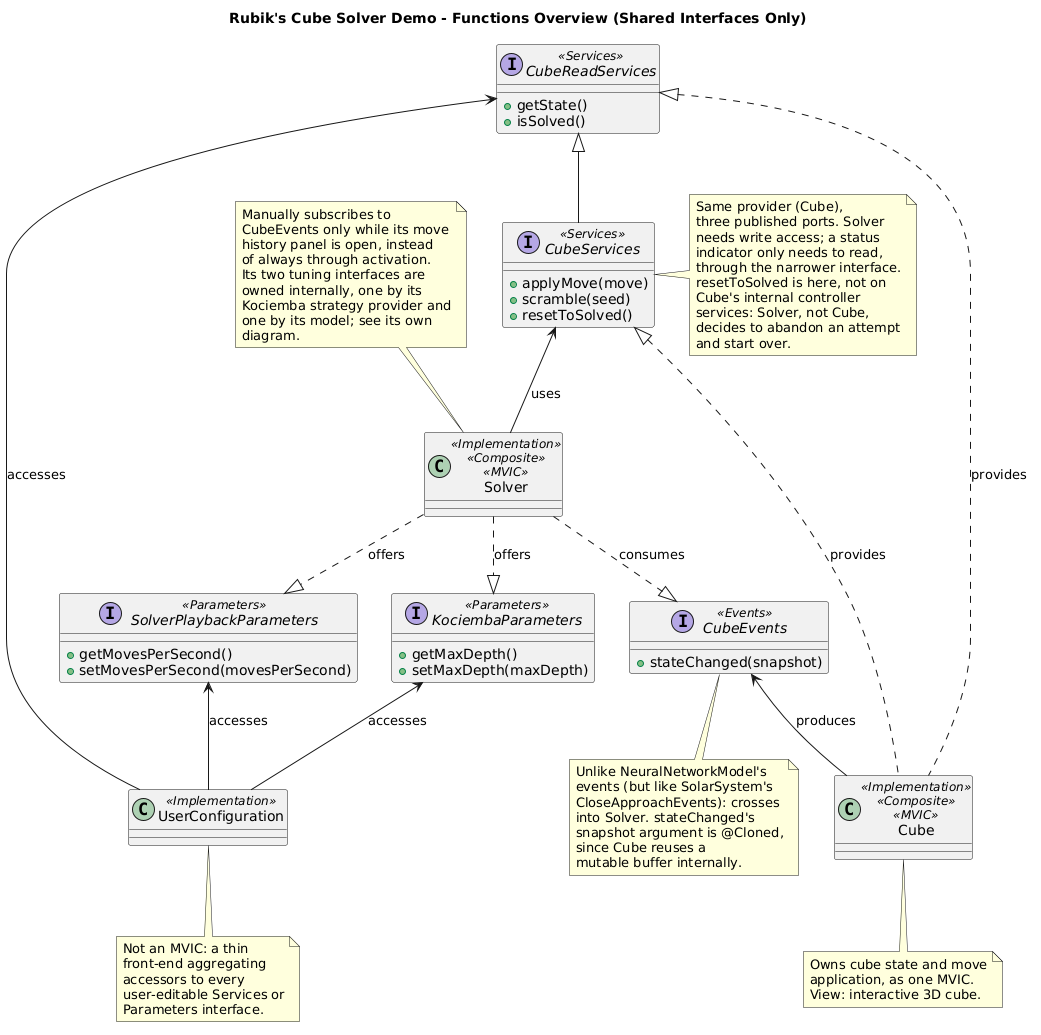
Cube exposes two public interfaces instead of one:
CubeServices extends CubeReadServices. CubeReadServices carries the
two read-only operations (getState(), isSolved()); CubeServices adds
the three that mutate the cube (applyMove(Move), scramble(long),
resetToSolved()). This is
extending services:
UserConfiguration is written against CubeReadServices alone, so it
structurally cannot call applyMove, scramble or resetToSolved, while Solver is
written against the wider CubeServices to play out a found solution.
Both interfaces are provided by the same class, CubeControllerImpl - the
split is about which callers can reach which operations, not about which
component implements them.
Solver uses CubeServices to apply moves, and consumes CubeEvents to
trace them (see Cube below for how). It offers two @Parameters
interfaces of its own, KociembaParameters (owned internally by the
Kociemba strategy provider) and SolverPlaybackParameters (owned by
SolverModel, the speed at which a found solution is played onto the
cube), both accessed externally by UserConfiguration, alongside
CubeReadServices for the cube’s solved status.
Per-Function Decomposition
Each function below is shown as its own MVIC, with full interface method signatures, plus the public interfaces it exposes to or consumes from the rest of the demo.
Cube
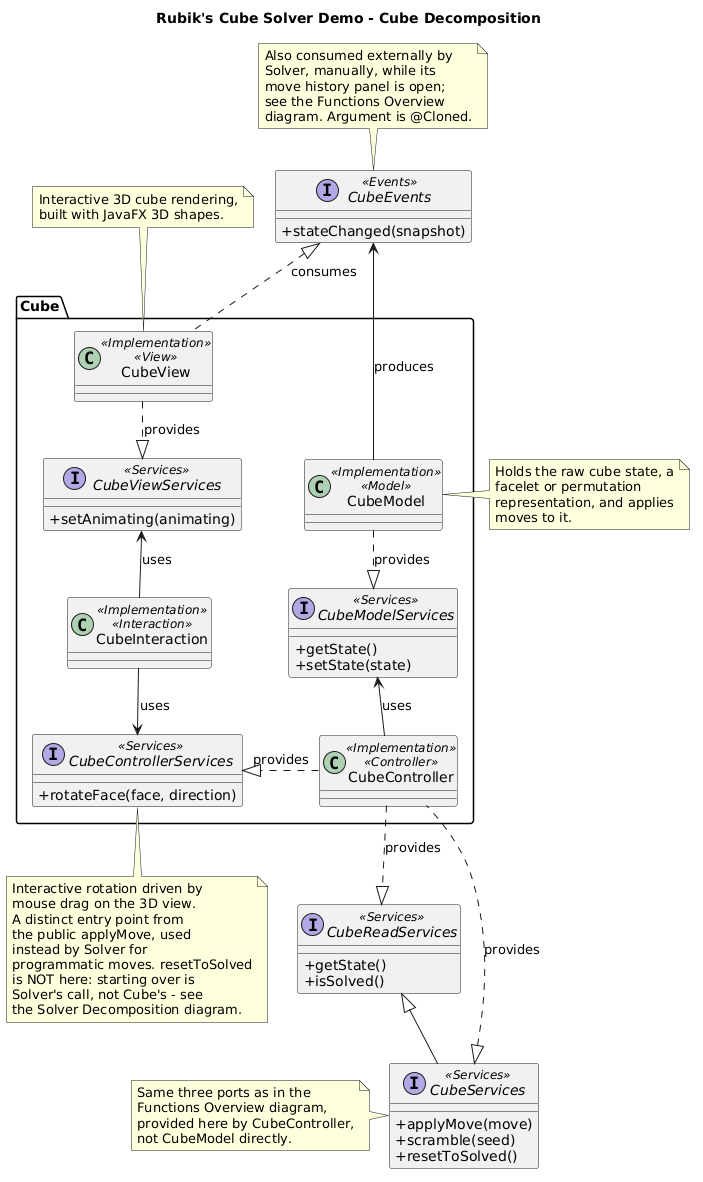
Owns the cube’s state and every operation that changes it, as one MVIC.
CubeControllerServices (rotateFace(face, direction)) is this
function’s own internal, interactive entry point, used only by CubeInteraction in response to a click; the
external CubeServices/CubeReadServices pair from
Functions Overview is what Solver and
UserConfiguration use instead. Both entry points end up at the same
implementation class, CubeControllerImpl, where rotateFace delegates to
applyMove. A move is applied to a clone of the current state, which is then
pushed back, so the state the Model holds is never mutated in place:
public void applyMove(final Move move) {
    CubeState next = this.useCubeModelServices.getState().clone();
    next.applyMove(move);
    this.useCubeModelServices.setState(next);
}
scramble(seed) deliberately starts from a fresh new CubeState()
rather than the current one, with 25 moves drawn from a Random seeded by
the caller - so repeated Scramble clicks don’t compound into an
ever-more-scrambled cube. resetToSolved() reuses that same
new CubeState() as the single source of truth for what “solved” means.
CubeModelServices.setState(...) both replaces the stored state and
fires CubeEvents.stateChanged(@Cloned CubeState snapshot). The
@Cloned argument matters here: CubeState is mutable and the instance
delivered is the one the Model holds (it is also what getState() returns),
so without cloning, every subscriber would hold a reference to that same
object and could alter the Model’s state by changing it. With @Cloned,
each subscriber receives its own copy.
CubeEvents declares its own @EventsSubscribe interface,
CubeEventsSubscribe, implemented by CubeModelImpl for
event subscription delegation
with a real catch-up push, not an empty body:
public void subscribe(final CubeEvents subscriber) {
    subscriber.stateChanged(this.state);
}
CubeEvents crosses the Cube/Solver function boundary, and has two
real subscribers, each wired differently. CubeView implements
CubeEvents directly with no @UsedEventsSubscribe field of its own, so
Covalent auto-subscribes it at activation and its first redraw comes from
that same catch-up push. SolverInteraction, by contrast,
subscribes manually, only while its move history panel is open, through
an explicit @UsedEventsSubscribe field typed to CubeEvents.CubeEventsSubscribe
itself - not through
GenericSubscribe:
Covalent only allows GenericSubscribe for an events interface that
declares no subscribe interface of its own, and CubeEvents already
declares one (CubeEventsSubscribe, needed for CubeModelImpl’s
delegation above), so manual subscription here goes through that same
specific interface instead. Declaring the field at all is also what keeps
SolverInteraction from being auto-subscribed at startup the way
CubeView is - a subscriber with no @UsedEventsSubscribe field is
auto-subscribed, one with a field is not, whichever subscribe interface
that field names.
Solver
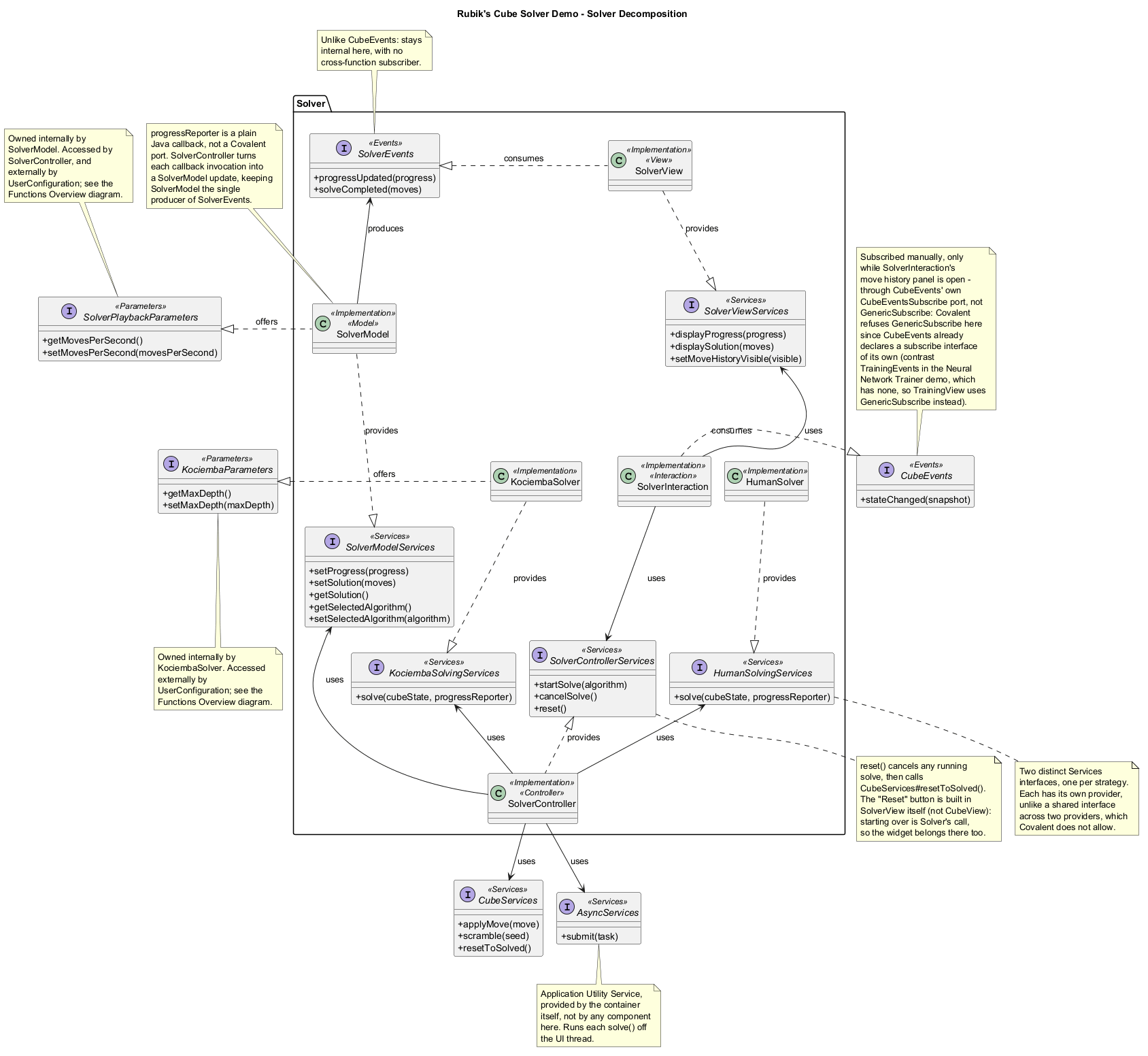
Coordinates two independent solving strategies, KociembaSolver and
HumanSolver, each composed inside SolverImpl as a plain
@Implementation alongside the function’s own MVIC quartet. Each strategy
provides its own Services interface (KociembaSolvingServices,
HumanSolvingServices) rather than the two sharing one: Covalent does
not allow two different component types to provide the same @Services
interface, so a shared “solving services” contract would only let the
first of the two actually provide it. SolverController is the single
consumer of both:
private Move[] solveWith(final SolvingAlgorithm algorithm, final CubeState cubeState,
        final ProgressReporter progressReporter) {
    return switch (algorithm) {
        case KOCIEMBA -> this.useKociembaSolvingServices.solve(cubeState, progressReporter);
        case HUMAN -> this.useHumanSolvingServices.solve(cubeState, progressReporter);
    };
}
a fan-out of two providers converging on one consumer, picking which one to call rather than reacting to events or filters.
Each solve, search then playback, runs off the UI thread through
AsyncServices,
the container’s own Application Utility Service, on a dedicated queue key
rather than the general pool:
this.useAsyncServices.submit(SOLVE_QUEUE_KEY, () -> {
            Move[] moves = this.solveWith(algorithm, cubeState, progressReporter);
            this.playSolution(moves, cubeState);
            return null;
        })
        .exceptionally(failure -> {
            this.reportSolveFailure(failure);
            this.solving.set(false);
            return null;
        });
The dedicated key is what makes cancellation meaningful:
cancelSolve() calls AsyncServices.releaseQueue(SOLVE_QUEUE_KEY), which
discards a not-yet-finished task on that key outright, interrupting a
search in progress. SolverController tells a cancelled solve
(CancellationException) apart from one that honestly exhausted its
search budget (SolveSearchExhaustedException, raised by either strategy
when its time budget, node budget or maximum depth is reached without
finding a solution) apart from an actual bug, reporting
each distinctly.
Progress flows back through ProgressReporter, a plain Java functional
interface rather than a Covalent events contract: since both strategies
would need to produce the same events interface, and Covalent does not
allow that either, SolverController instead hands each strategy its own
lambda, built fresh per solve, that forwards every callback straight into
SolverModelServices.setProgress(...). This keeps SolverModel the one
and only producer of SolverEvents (progressUpdated, solveCompleted),
with neither strategy ever touching an events port directly.
The Kociemba strategy runs the classic two-phase search - reach the G1
subgroup, then solve within it - on a cube described by its small cubes,
guided by distance tables built once, when the strategy first runs (well
under a second), by a breadth-first search over small coordinates of the
cube. It solves any cube, usually in 20 to 25 moves and in a few
milliseconds, and replays its answer on a copy of the cube to check it. Its
phase-2 depth cap is offered through KociembaParameters. The Human strategy follows the beginner
layer-by-layer method in seven steps (first-layer cross, first-layer
corners, middle-layer edges, last-layer cross, last-layer edges, last-layer
corner positions and corner orientations), each one a short search over
single turns or textbook algorithms for the next piece to place, without
tunable parameters. Both strategies apply every move they consider through the same CubeState.applyMove(...)
the rest of the demo already uses, never a second, hand-duplicated move
engine, and every move a solve returns was genuinely applied along the way
to reach the state it claims - a returned solution is always real,
whatever the search’s own guidance was like getting there.
Unlike CubeEvents, SolverEvents stays entirely internal to the
Solver function: SolverView consumes it directly, auto-subscribed
simply by implementing the interface, and SolverModelImpl implements no
subscription delegation for it, since a solve is short-lived and
user-triggered rather than persistent state a late subscriber would need
catching up on.
UserConfiguration is a thin, cross-cutting composite with no domain
state of its own - a View/Interaction pair, no Model or Controller -
that gathers KociembaParameters, SolverPlaybackParameters and
CubeReadServices behind one panel. Its solved-status indicator is a
one-shot read of CubeReadServices.isSolved() at activation rather than a
live subscription to CubeEvents, so it shows the status the cube had when
the panel activated and does not follow later moves the way CubeView
does.
HMI Assembly
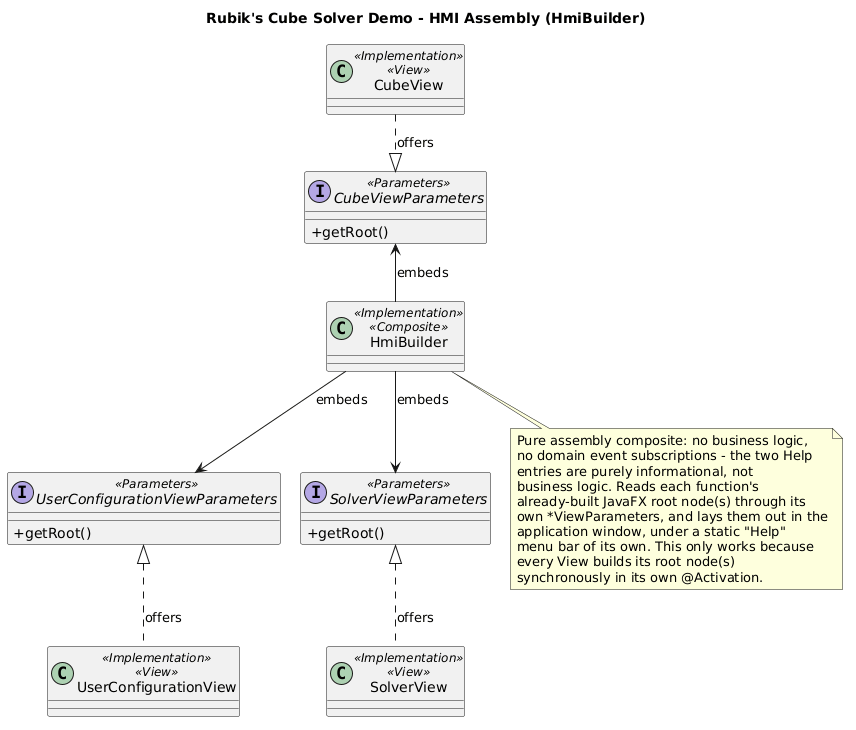
HmiBuilder reads three *ViewParameters interfaces - Cube, Solver
and UserConfiguration, each a simple getRoot() - and lays out the cube
view centered, the solver view to its right, and the configuration panel
to its left. As in the other demos, this composite is pure assembly -
no business logic, no domain event subscriptions - and only works because
every View builds its root node synchronously in its own @Activation, so
every root already exists by the time HmiBuilder activates and reads
these parameters.
HmiBuilder also wires one piece of code of its own, beyond assembly: a
static “Help” menu, with an “About Rubik’s Cube Solver” entry summarizing
what the demo does and which Covalent mechanisms it illustrates, and a
“Using Rubik’s Cube Solver” entry describing its controls - exactly as in
the other three demos (see Neural Network Trainer -
Architecture).
This demo has no “View” menu of its own - that addition is specific to
Solar System Simulation’s dark/light theme switch.
Home | Previous: Ecosystem - Architecture | Next: Covalent Annotations Cheat Sheet